Beyond Scale: Why Lean, Open-Source AI is the Future of Trust and Reliability
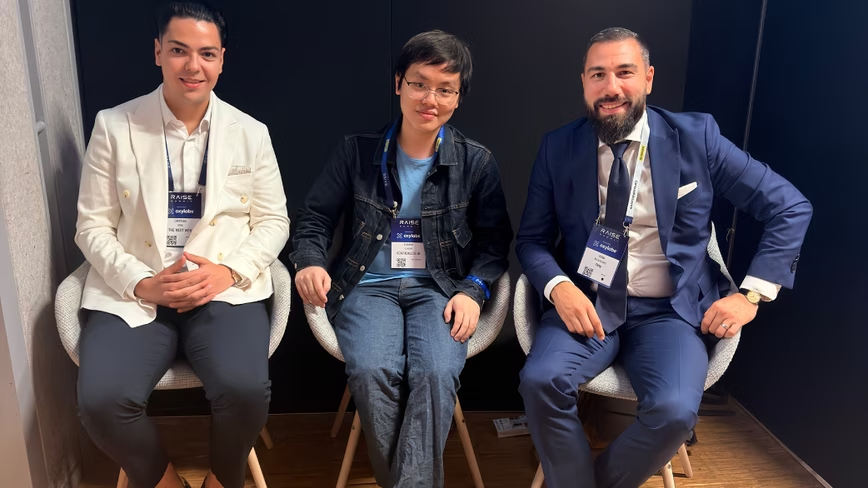
In the rapidly evolving landscape of artificial intelligence, a prevailing narrative often champions the pursuit of ever-larger, more complex models. However, an alternative, equally compelling vision is emerging, one that prioritizes efficiency, reliability, and accessibility. Eugene Cheah, CEO and co-founder of Featherless AI, stands at the forefront of this movement, advocating for a future where AI's true value lies not in its scale, but in its trustworthiness and widespread utility.
Redefining AGI: The Imperative for Reliability
The concept of Artificial General Intelligence (AGI) frequently conjures images of "superintelligence" or an "Einstein in a box." Cheah, however, offers a more grounded and practical perspective. He posits that for enterprises, the immediate need isn't necessarily for a smarter model, but for a more reliable one. Current advanced models, despite their impressive capabilities, often struggle with basic transactional tasks, achieving only moderate success rates. This unreliability presents significant hurdles for real-world business integration.
Cheah's definition of AGI, or "personal general intelligence," describes an AI capable of learning through iterative feedback within a specific context—much like a human learning to cook through trial and error. From a digital forensics standpoint, this emphasis on reliability is paramount. In any investigation, the integrity and trustworthiness of data, systems, and their outputs are non-negotiable. An AI system that is unreliable, unpredictable, or whose outputs cannot be consistently verified poses a substantial challenge to forensic analysis and the establishment of credible evidence. The shift towards reliability in AI development directly supports the foundational principles of digital forensics, where consistency and verifiability are key.
The Open-Source Advantage: Accessibility, Privacy, and Auditing
Featherless AI's core mission is to democratize access to the vast universe of open-source AI models. By hosting over 40,000 models and making them accessible via a single API, the company addresses a critical need for researchers and businesses to experiment and innovate freely. This approach not only fosters innovation but also champions crucial aspects like data sovereignty, privacy, and security.
For example, Featherless AI offers private cloud deployments, enabling organizations to run frontier-quality models like GLM 5.2 on dedicated hardware, keeping all operations within their own trust boundaries. This level of control is invaluable for industries with stringent regulatory requirements or high-security concerns.
From the perspective of a digital forensic investigator, the open-source paradigm offers significant advantages. Unlike proprietary "black box" AI systems, open-source models, when properly audited and built on transparent datasets, provide a far greater degree of scrutiny and verifiability. The ability to examine the underlying code, understand training methodologies, and audit datasets fosters trust and allows for deeper forensic analysis. This transparency is vital for establishing the provenance of AI-generated content, detecting potential biases, or investigating malicious AI use cases, such as the creation of deepfakes or sophisticated phishing campaigns. The move towards "neutral, fully audited open-source models" is a critical step in building trustworthy AI ecosystems, a principle that resonates strongly with the integrity requirements of blockchain technology and forensic examination.
Architectural Innovation and the Future Trajectory of AI
Cheah highlights a fundamental architectural challenge with current transformer models: their quadratic scaling of cost with longer contexts. This inefficiency points to the need for exploring next-generation architectures, such as linear transformers and other alternatives, to achieve true general intelligence. He likens the current state to the early days of the steam engine, suggesting we've only begun to scratch the surface of AI architectural possibilities.
Looking ahead, Cheah draws parallels between the evolution of AI and the software industry, where open-source solutions eventually outpaced proprietary offerings in operating systems and databases. He predicts a similar trajectory for AI, albeit at a much faster pace, driven by the inherent financial incentives and collaborative power of the open-source community. This ongoing architectural evolution means that digital forensic investigators must continuously adapt their methodologies and tools to understand and analyze new AI paradigms. The ability to forensically examine novel AI systems, verify their outputs, and trace their operational logic will be paramount in an increasingly AI-driven world.
The future of AI, as championed by Eugene Cheah and Featherless AI, is not solely about size or computational brute force. It's about building lean, reliable, accessible, and auditable systems. This shift has profound implications for digital forensics, blockchain integrity, and overall cybersecurity, emphasizing the critical need for transparency, trust, and verifiability in all AI applications.
Need expert assistance with digital forensics, blockchain investigation, or OSINT? Agam Setyono provides professional consultation services. Get in touch for a confidential discussion.